Efficiency Doesn't Save Resources. It Spends Them Faster.
2026-05-02
By Vadym · Generated with Boba, curated by me
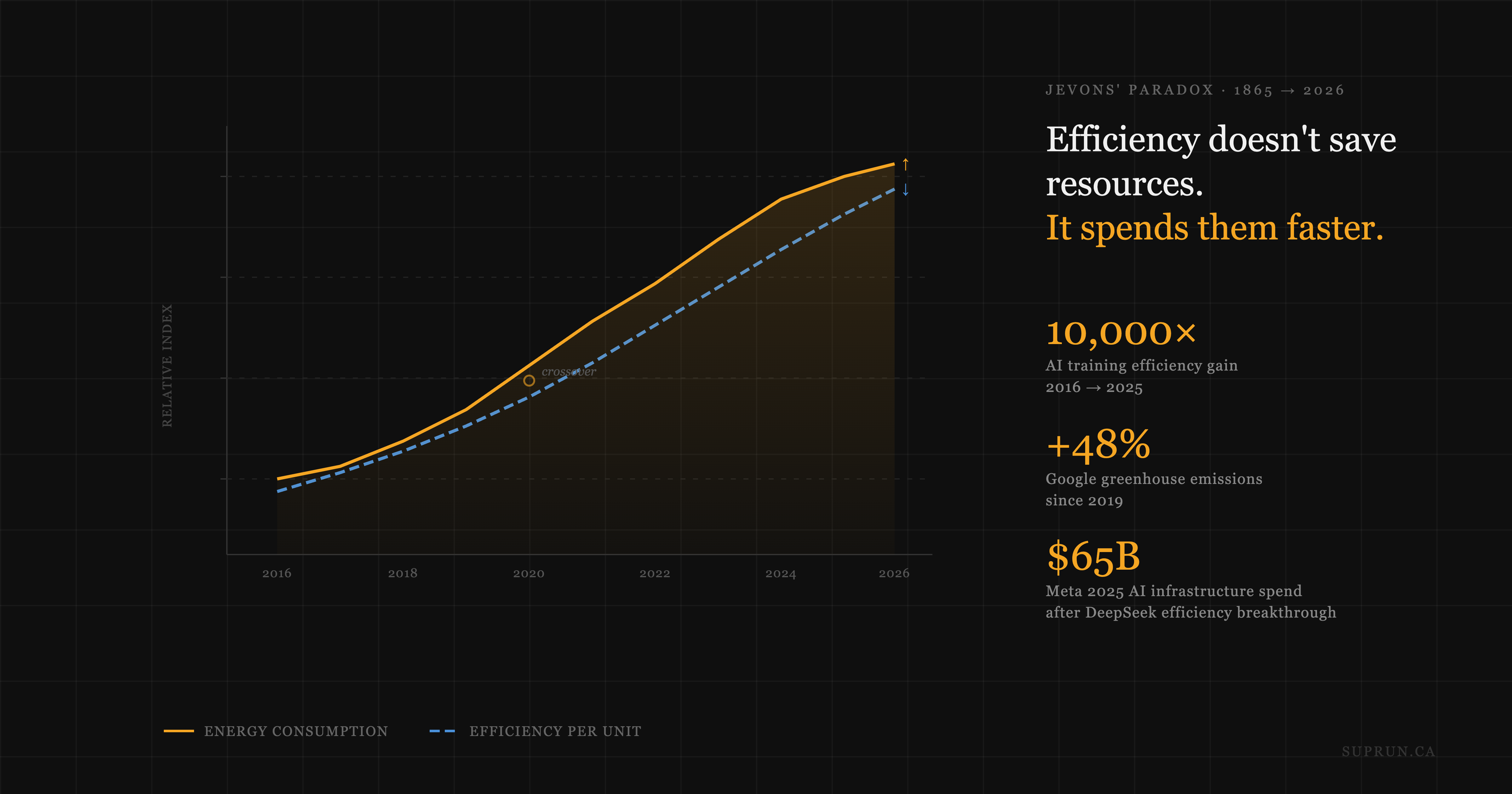
In 1865, a British economist named William Stanley Jevons published a book called The Coal Question. His central argument was unsettling: Britain's coal reserves were finite, and the country was burning through them at an accelerating rate. The alarming part wasn't the consumption itself — it was the mechanism behind it. Jevons had noticed that as steam engines became more efficient, coal consumption went up, not down. Each improvement made coal cheaper to use, which made it worthwhile to use in more places, for more things, by more people. The technology got leaner and the total footprint grew. Jevons called it a paradox. Economists eventually named it after him.
The intuition runs against us. We want efficiency to mean conservation. We picture a tighter machine that does the same work with less fuel, and we assume that adds up to less fuel consumed in total. Jevons showed that this is exactly backwards. Make a resource cheaper to use, and you don't use less of it — you use it where you couldn't afford to before. You invent new uses. You scale. The savings get absorbed and then some. This is the Jevons Paradox: efficiency improvements drive consumption up, not down.
It took 161 years for the paradox to find a cleaner demonstration than British coal. That demonstration is happening right now.
In January 2025, a Chinese AI lab called DeepSeek released a reasoning model it claimed to have trained for roughly $5.6 million. OpenAI had reportedly spent somewhere around $100 million to train GPT-4. The gap was staggering — a 95% cost reduction for comparable capability. The immediate market reaction was panic. Nvidia lost nearly $600 billion in market cap in a single day. The logic was straightforward: if AI gets cheap to build, we'll need fewer GPUs. Jevons would have recognized the reasoning as the same mistake his contemporaries made about coal.
What happened next: Microsoft CEO Satya Nadella posted "Jevons paradox strikes again!" on social media. Meta raised its 2025 AI infrastructure spending guidance to $60–65 billion — a 50% year-over-year increase — and cited DeepSeek's efficiency breakthrough as the reason. GPU demand didn't soften; it intensified. The cheaper it became to run AI, the more people wanted to run it.
This is what Jevons looks like at civilizational scale. Nvidia shipped 3.7 million GPUs in 2024, more than a million more than the year before, despite the fact that its latest architecture is 25x more energy efficient than the 2022 generation. The company claims a cumulative 10,000x efficiency gain in AI training and inference from 2016 to 2025. Total AI energy consumption has gone up every year by orders of magnitude.
For developers specifically, the mechanism is granular and immediate. AI coding tools don't make engineering teams smaller — they make engineers faster, which expands what teams attempt. Nobody ships the same product with fewer people; they ship a more ambitious product with the same people. Inference costs per API call have dropped dramatically over the past two years. The result isn't fewer API calls; it's AI integrated into workflows that would have been economically absurd at 2023 prices. Better models don't reduce context usage — they justify sending more context because the model can actually use it. Every efficiency improvement in AI becomes a new floor, not a ceiling.
The energy numbers behind this are serious. Global data center electricity consumption hit around 415 terawatt-hours in 2024 — about 1.5% of global electricity use, growing at 12% per year, four times the rate of global electricity demand overall. The IEA projects data center consumption will exceed 945 terawatt-hours by 2030, potentially reaching 1,300 terawatt-hours by 2035. US data centers alone are on track to consume more electricity by 2030 than all US energy-intensive manufacturing combined — steel, aluminum, cement, chemicals. AI-optimized facilities are projected to more than quadruple their electricity demand by the end of the decade.
Google's data centers operate at a Power Usage Effectiveness ratio of around 1.1 — extraordinary efficiency by any engineering standard. Google's greenhouse gas emissions are up 48% since 2019. Microsoft improved its cooling efficiency and watched its water consumption increase 34% in a single year. The paradox isn't a prediction; it's the observed result.
The Fear That Gets the Direction Wrong
There's a version of this story that's supposed to be about jobs. If AI can write code, the reasoning goes, we'll need fewer developers. Teams will shrink. The profession will contract. It's a reasonable fear — and it has the direction exactly backwards.
The Jevons frame predicts the opposite. When the cost of building software drops, demand for software doesn't hold steady — it expands. Most software that companies want has never been built, not because of a lack of ideas, but because it was too expensive to justify. A mid-market logistics company doesn't have a custom inventory system because a custom inventory system cost $500K to build. That ceiling is moving fast. When it drops enough, the company builds the system. And building the system requires engineers.
The history of software productivity tools follows a consistent pattern. Compilers didn't eliminate programmers — they made programming accessible to more people, which grew the field. IDEs made developers faster, which expanded what teams could attempt, which created more teams. Cloud infrastructure removed the need to manage physical servers, which meant more companies could run software, which meant more software to build. Open source frameworks collapsed the cost of common problems, which freed engineers to tackle harder ones. Every tool that made software cheaper to produce correlated with more engineers, not fewer.
This isn't a coincidence. Software has always been supply-constrained. The amount of software the world wants — the automations, the tools, the products, the internal systems — vastly exceeds what's been built. Cheaper development doesn't close that gap and eliminate demand. It makes previously out-of-reach software economically viable, which expands the gap in the other direction. The floor drops, the ambition level rises to meet it, and you need more people to execute.
AI coding tools are doing this now. Teams aren't shrinking — they're attempting products they wouldn't have proposed two years ago. The constraint shifts from "can we build this?" to "what should we build next?" That's more work, not less. The developers who understand this won't be displaced by AI. They'll be building things that couldn't exist without it.
The uncomfortable implication is that there is no natural "we'll use less" equilibrium once a technology becomes efficient enough to spread. Coal didn't stabilize when engines improved. Computing didn't stabilize when transistors shrank. AI won't stabilize because inference gets cheaper. Cheaper means more uses, more users, more demand. The feedback loop doesn't have a built-in off switch.
So what does this mean for how you think about the tools in front of you?
The Jevons framing changes the question. The standard question around AI adoption is: will this make us more efficient? It almost always will. That's not wrong as an observation — it's just incomplete as an analysis. Efficiency is not the destination; it's the ignition. The more useful question is: what new demand will this unlock?
That shift matters practically. If you're evaluating whether to integrate AI into a product, you're not just deciding whether it improves the existing workflow. You're deciding what new scope becomes possible that wasn't before. If you're thinking about infrastructure, you're not calculating whether cheaper inference means lower bills — you're asking what you'll build once the economics permit it. The teams and companies that will define the next five years aren't the ones that got a little more efficient. They're the ones that understood that cheaper AI was permission to attempt something previously out of reach.
Jevons didn't write the paradox as a warning exactly. It was more like a correction — a redirect away from a comforting story about how efficiency leads to moderation, toward a less comfortable story about how it leads to growth. That story is playing out in real time, in the infrastructure beneath every model you call. Whether the growth is net positive or net catastrophic depends on questions that nobody has answered yet. But the first step is seeing it clearly: making AI cheaper doesn't slow anything down. It speeds everything up.