Why the AI Cycle Is Compressing
2026-05-22
By Vadym · Generated with Boba, curated by me
Why the AI Cycle Is Compressing
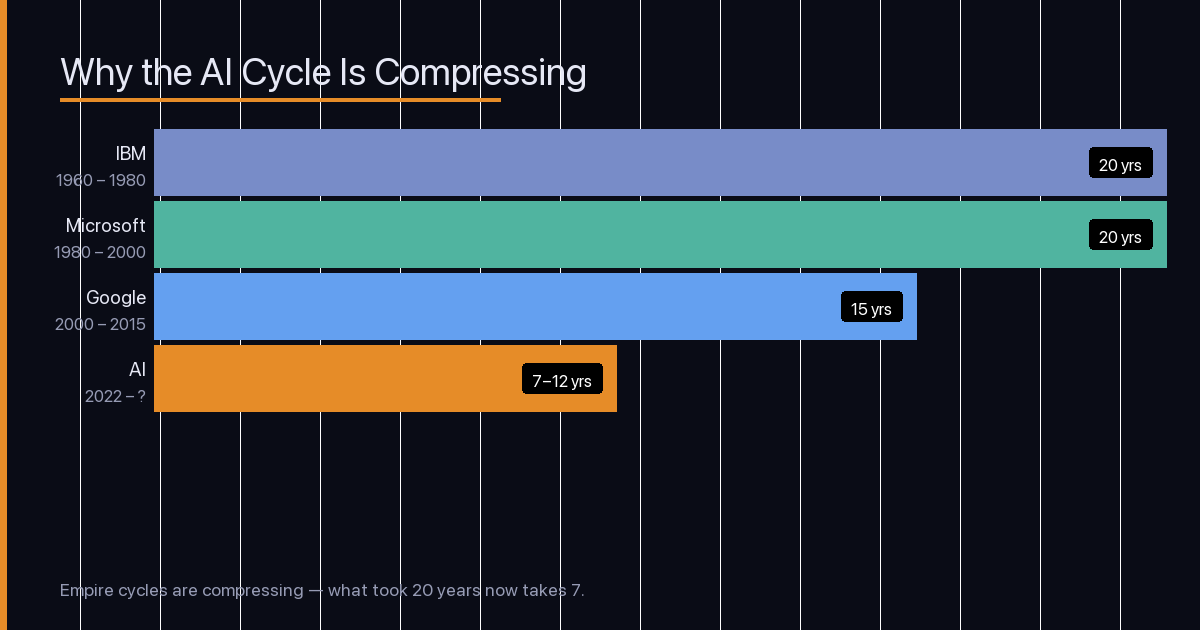
The IBM mainframe era lasted about 20 years. Microsoft's PC era lasted 20 years. Google built and consolidated its search empire over 15 years. The cloud era took AWS roughly 15 years to reach maturity.
The AI era? Analysts project 7–12 years. And that might be optimistic.
Empire formation that used to take decades is now happening in years. A pattern that stretched across a generation is compressing into a single career phase. Understanding why matters — because when cycles compress, the windows for action shrink with them.
What "The Cycle" Actually Means
Every major technology wave follows the same arc: invention, land rush, platform wars, empire consolidation, disruption by the next wave. IBM moved through all five stages from the 1960s to the 1980s. Microsoft from the 1980s to the early 2000s. Each cycle took roughly a generation before consolidation locked in.
ChatGPT launched in December 2022. By 2025, AI had captured 61% of global venture capital — the highest share any single sector has ever taken. The land rush phase, which historically takes years, was effectively over in 18 months.
Four Reasons It's Moving Faster
1. Software compresses everything.
Building an AI company doesn't require factories or physical distribution. The bottlenecks — compute and talent — can be rented or hired faster than hardware can be manufactured. Anthropic grew from $1B ARR to $14B ARR in 14 months — then to $44B ARR by mid-2026, doubling roughly every six weeks. That's the fastest B2B revenue acceleration ever recorded. It would have been physically impossible for any hardware-dependent company in any prior cycle.
2. Capital is concentrating at unprecedented speed.
In 2025, $258.7B flowed into AI — but the structure is what matters: 73% of it landed in deals over $1B. The middle market is being skipped. Companies either secure massive capital at massive valuations or compete without it. OpenAI's late-2025 secondary alone moved more capital than the entire Series A market for SaaS in 2015. When capital concentrates this fast, the platform wars phase — which normally takes years — gets forced into quarters.
3. The hyperscalers are building the rails in real time.
AWS, Azure, Google Cloud, Meta, and Oracle are on track to spend over $700 billion on AI infrastructure in 2026 alone — more than the total global telecom capex during the dot-com buildout. Previous cycles required infrastructure to be built before the app economy could explode — cell towers, data centers, cable networks. This time, infrastructure buildout, model development, and application deployment are happening simultaneously. There's no waiting for the rails.
4. The talent wars collapse the research-to-deployment gap.
In 1975, a Bell Labs breakthrough might reach commercial application in a decade. Today, a research paper becomes an API endpoint in six months. Meta paid $100M+ packages to poach individual researchers from OpenAI and Anthropic. When a handful of researchers determines the outcome of a trillion-dollar market, moving fast on talent is existential — and that urgency collapses the timeline between idea and product.
What History Says
The IBM parallel is instructive. IBM ruled by controlling the hardware stack — mainframes, operating systems, software, service contracts. Everything bundled, everything proprietary. When Microsoft captured the OS layer and Intel captured the chip layer, IBM's hardware lock-in became irrelevant. IBM pivoted to services but never recaptured empire status.
Microsoft learned from IBM: own the layer above the hardware, then own the layer above that. What finally weakened Microsoft wasn't a better OS — it was the internet making the OS less relevant. The browser became the new platform. Microsoft missed the search wave, recovered with cloud, and is now betting $120B+ in annual capex on AI to become the next empire.
Google built its empire on PageRank and monetized it through advertising — $238B in ad revenue in 2025. AI now threatens Google at the foundation: if users get answers from ChatGPT or Perplexity, they skip Google Search and skip the ads that fund everything. Google has the technology to fight back (DeepMind, Gemini 2.5 Pro). What it may lack is the structural incentive to cannibalize its own revenue model fast enough. The empire's biggest risk is its own success.
The pattern across every cycle: incumbents have the resources but fight structural incentives to self-disrupt. Challengers move fast but lack distribution. The winner is whoever controls the layer that becomes most essential — not the layer that was most exciting at the start.
Where AI Is in the Cycle Right Now
We're somewhere between Land Rush and Platform Wars — and the transition is moving faster than most people realize.
The signals are hard to miss:
- OpenAI closed a funding round at $852B valuation in March 2026
- Anthropic grew 14x in 14 months — then passed OpenAI in revenue entirely, reaching $44B ARR by mid-2026
- The top five AI labs collectively represent over $1.5 trillion in enterprise value
- Chinese open-source models went from 1% to 15% global market share in one year
- The vast majority of the ~90,000 AI companies launched since 2020 will not survive to 2028
The consolidation isn't coming — it's started. The companies that look like winners right now (OpenAI, Anthropic, Google DeepMind, NVIDIA, Microsoft) are locking in the infrastructure positions and distribution moats that will define the empire map for the next decade. The question isn't whether consolidation happens. It's whether you're on the right side of it before the window closes.
What Compression Means for Everyone Else
When cycles compress, three things happen to everyone who isn't at the top of the stack.
Windows close faster. Cursor went from $100M ARR in January 2025 to $2B ARR by April 2026 — and from a $29B valuation to $50B+ in the same stretch. That trajectory won't be available to the next developer tool in the category. Platform wars make categories winner-take-most, and the winning position fills up before most people realize the race is on.
The vassal dynamic arrives sooner. In a normal tech cycle, the API dependency era — thousands of companies entirely dependent on a larger platform — takes years to set in. In AI, it's already here. Companies built on OpenAI's API feel every pricing change, every model deprecation, every shift in terms immediately. Over 50,000 companies built on AI APIs in 2024 alone. They're building on someone else's territory, and the landlord is still figuring out the rent.
The next disruption wave starts before the empire is mature. Physical AI, robotics, bio-AI — the next wave is already visible while the current empire is still forming. The Jevons Paradox applies: each efficiency gain creates demand for the next level of capability. The cycle never fully rests.
The Safest Bet
NVIDIA is the safest long-term position in a compressed cycle, for the same reason the terrain is always more durable than any empire built on it. NVIDIA doesn't fight the model wars, the enterprise wars, or the developer tools wars. It collects 80%+ of the revenue from all of those wars simultaneously, selling compute to every combatant. Its data center revenue hit $193.7B in FY2026 — up 68% year-over-year — at gross margins of 75% — empire-tier economics without empire-tier risk. No matter who wins, NVIDIA gets paid.
The riskiest position: building on a single empire's API without a migration path. When the cycle is compressing, empires change faster than you'd expect — and the vassals change with them.
The one prediction I'm confident in: by 2030, the AI empire map will look less like today and more like the cloud market of 2020 — mature, concentrated, predictable. The open question is which names survive to be on it.
That window is closing. Faster than any previous cycle. The question is what you do with that fact.
This post draws on an AI Companies as Empires research report compiled in April 2026. Valuations and revenue figures reflect publicly available data as of May 2026.